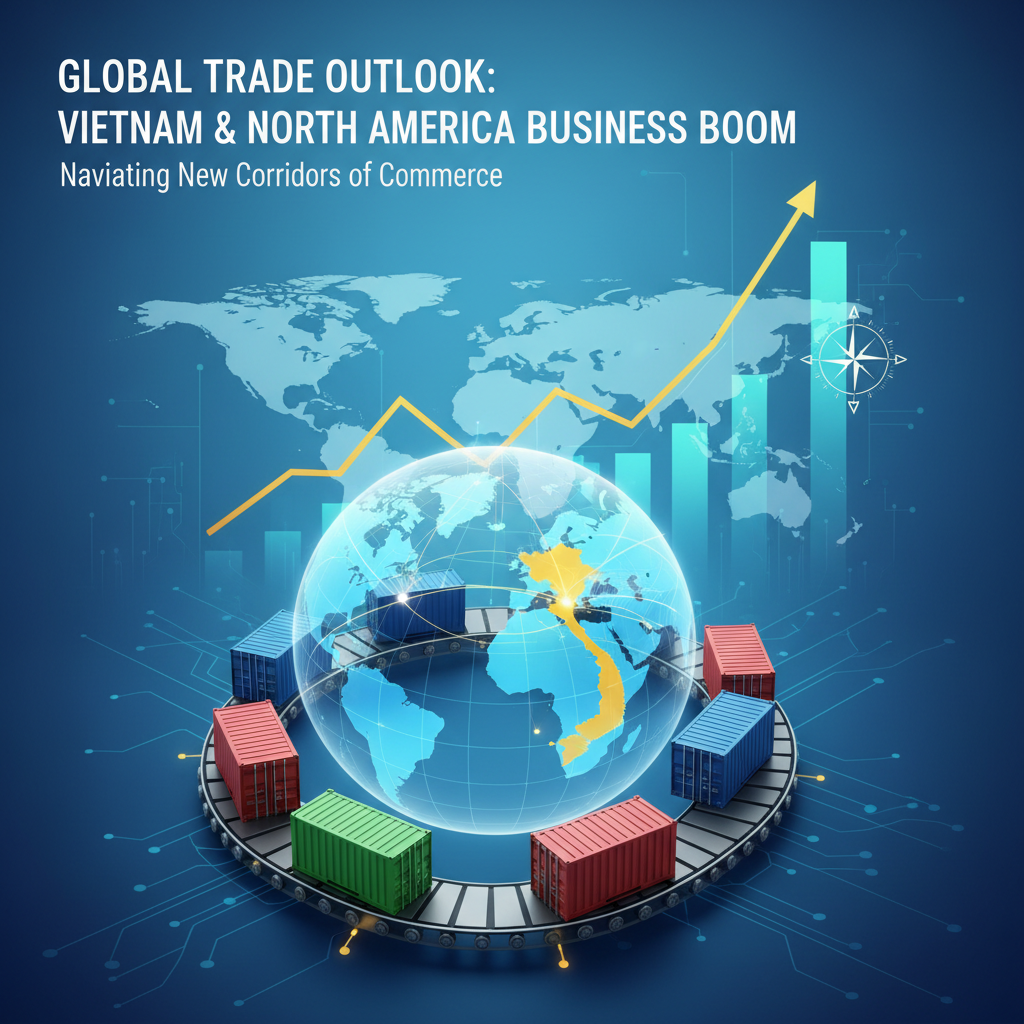
Trade Trends in a Globalized Landscape: Insights from Recent Developments
A look into global import/export dynamics, Vietnam's rising prominence in garment manufacturing, and the evolving trade landscape in North America reveals significant insights for industry professionals.
Trade Trends in a Globalized Landscape: Insights from Recent Developments
In an increasingly interconnected world, global trade dynamics are constantly shifting. Recent developments in U.S. trade policy, along with the growth of emerging markets like Vietnam, shed light on key trends affecting exporters and importers in multiple sectors. As we navigate through the complexities of international trade, understanding these dynamics is essential for trade professionals seeking to optimize their strategies and make informed decisions. This article explores recent trends in global imports and exports, Vietnam's burgeoning trade role, and insights from the North American trade landscape.
1. Global Import/Export Trends
February 2026 witnessed a widening of the U.S. trade deficit, which increased to $57.3 billion, up from $54.7 billion in January. This increase was largely driven by a surge in imports, particularly in core capital goods such as computers, where imports rose by $5.4 billion. While export growth also saw an increase of $12.6 billion, a significant portion was attributed to a volatile $8 billion surge in nonmonetary gold exports.
Why does this matter? Speculative financial activity, as reflected in gold exports, often obscures the underlying health of the economy since these flows are excluded from GDP calculations. On the other hand, the growth in imports signals strong domestic demand but raises concerns about dependency on foreign goods, particularly tech components. As companies increasingly pivot to prioritize production and supply chain resilience, understanding import sources and dynamics has never been more critical.
For trade professionals, this scenario highlights the necessity for agile supply chain strategies. Companies must evaluate their dependency on foreign markets and consider diversifying suppliers, particularly in IT and manufacturing sectors where technological advancements are crucial. Furthermore, the surge in computer-related imports places added pressure on workforce development and skill acquisition in these key areas.
2. Vietnam's Emerging Trade Activities
Vietnam's garment industry has emerged as a significant player in global markets, especially in light of recent changes to U.S. trade policy. Under President Trump's administration, the decision to impose tariffs on countries with trade surpluses, including China, catalyzed a shift in production to Vietnam. The U.S. brands, now highly reliant on Vietnamese manufacturers due to favorable conditions like a negotiated lower tariff rate of 20% and the EU-Vietnam free trade deal, have made Vietnam the top clothing supplier to the U.S. as of 2025.
The shift signifies more than just numbers; it symbolizes a changing landscape in global supply chains. For U.S. businesses, this scenario provides a strategic opportunity to engage with Vietnamese manufacturers, integrating quality and cost-effective labor into their production processes. But on the flip side, companies must navigate potential increases in tariffs, such as the recently announced 20% import tariff on Vietnamese goods, which could impact overall profitability.
The policies are also a double-edged sword, as they seek to balance trade deficits while mitigating the influence of China in the region. For trade professionals, understanding the nuances between U.S.-Vietnam trade agreements and tariffs will be essential in forecasting market changes and optimizing supply chains. With production capacity increasingly high in Vietnam, businesses can capitalize on this growth by exploring partnerships and investments in manufacturing capabilities.
3. North America Trade Insights
The landscape of North American trade is currently under scrutiny, particularly with ongoing reviews of the United States-Mexico-Canada Agreement (USMCA). Canadian Prime Minister Mark Carney recently emphasized Canada’s stance that the U.S. should not dictate terms in trade renegotiations. His assertion brings attention to the importance of collaboration among U.S., Canadian, and Mexican stakeholders in addressing trade irritants—each country has vital interests at stake.
At the same time, optimism surrounding U.S.-Canada trade relations has also emerged. Canadian officials, including Trade Minister Dominic LeBlanc, indicated confidence in reaching favorable trade deals following the removal of retaliatory tariffs. This sentiment represents a critical moment for businesses operating in North America, suggesting potential for more stable trade relations and improved market access.
For trade professionals, staying informed about the evolving political landscape is vital. Engagement in trade discussions and awareness of policy shifts will empower businesses to adapt quickly to new regulations and leverage competitive advantages. Organizations should prioritize building robust relationships with key stakeholders in both Canada and the U.S. to ensure their interests are represented effectively in negotiations.
Key News Sources
- Trade Deficit Widens as Surging Imports Outpace Gold-driven Export Growth - Kiplinger
- How Vietnam's Garment Factories Benefited from Trump's Trade Policy - Le Monde
- Canada's Prime Minister Says the US Does Not Get to Dictate Terms for a Trade Agreement - Associated Press
- Trump Announces Vietnam Trade Deal With 20% Import Tariff - Bloomberg Podcasts
- Canada Bullish on Prospects for US Trade Deal, Key Minister Says - Bloomberg Podcasts
Conclusion
The world of trade is complex and ever-evolving, dictated by policies, market demands, and geopolitical developments. By understanding the implications of current trends in global imports and exports, alongside Vietnam's ascent in the garment industry and the dynamics of North American trade discussions, trade professionals can navigate these challenges proactively. Staying informed and responsive to market changes will ensure sustained growth and competitive positioning in an increasingly interconnected trade environment.
Key News Sources
-
Trade Deficit Widens as Surging Imports Outpace Gold-driven Export Growth (Kiplinger) In February 2026, the U.S. trade deficit widened to $57.3 billion, up from $54.7 billion in January, driven by a $15.2 billion increase in imports that outpaced a $12.6 billion growth in exports. A significant portion of the export increase was due to a volatile $8 billion surge in nonmonetary gold exports, which are excluded from GDP calculations as they often represent speculative financial activity. The import surge was led by core capital goods, notably a $5.4 billion rise in computer imports, along with increases in computer accessories and semiconductors.
-
How Vietnam's Garment Factories Benefited from Trump's Trade Policy (Le Monde) Vietnam's garment industry significantly benefited from changes in U.S. trade policy under President Donald Trump's second term. When Trump imposed broad tariffs on countries with trade surpluses with the U.S., including Vietnam, Hanoi negotiated a lower rate of 20% — less than half of the threatened 46%. This, combined with higher duties on Chinese imports, spurred a surge in U.S. brands shifting production to Vietnam, making it the top clothing supplier to the U.S. by 2025, even surpassing China. American and European companies, such as Ariat, Topo, Adidas, and Zara, increasingly turned to Vietnam due to favorable trade agreements like the EU-Vietnam free trade deal and to avoid Chinese tariffs.
-
Canada's Prime Minister Says the US Does Not Get to Dictate Terms for a Trade Agreement (Associated Press) Canadian Prime Minister Mark Carney asserted that the United States does not have unilateral authority to dictate terms in renegotiations of the United States-Mexico-Canada Agreement (USMCA). Speaking in Ottawa ahead of a scheduled review in July, Carney emphasized the importance of balanced negotiations among all involved nations and noted that both Canada and the U.S. have trade irritants to address. His remarks followed reports that U.S. officials are demanding concessions and imposing an "entry fee" before formal trade discussions begin.
-
Trump Announces Vietnam Trade Deal With 20% Import Tariff (Bloomberg Podcasts) President Donald Trump announced a trade deal with Vietnam, imposing a 20% tariff on Vietnamese exports to the U.S., with a 40% levy on any goods deemed to be transshipped through the country. In exchange, Vietnam agreed to drop all levies on U.S. imports, effectively opening its market to American goods. The deal aimed to address trade imbalances and was part of a broader strategy to counter China's influence in the region.
-
Canada Bullish on Prospects for US Trade Deal, Key Minister Says (Bloomberg Podcasts) Canada is confident of reaching a trade deal with the U.S. after scrapping most of its retaliatory tariffs, according to a senior minister in Mark Carney's government. "We're optimistic that we can work with President Trump and his administration and come to an agreement that can be beneficial to the economy of both countries," Dominic LeBlanc, the minister responsible for Canada-US trade, said in a Bloomberg Television interview. He cited the conversations he has been having with Commerce Secretary Howard Lutnick, as well as Carney's communications with President Donald Trump.
Last updated: May 7, 2026