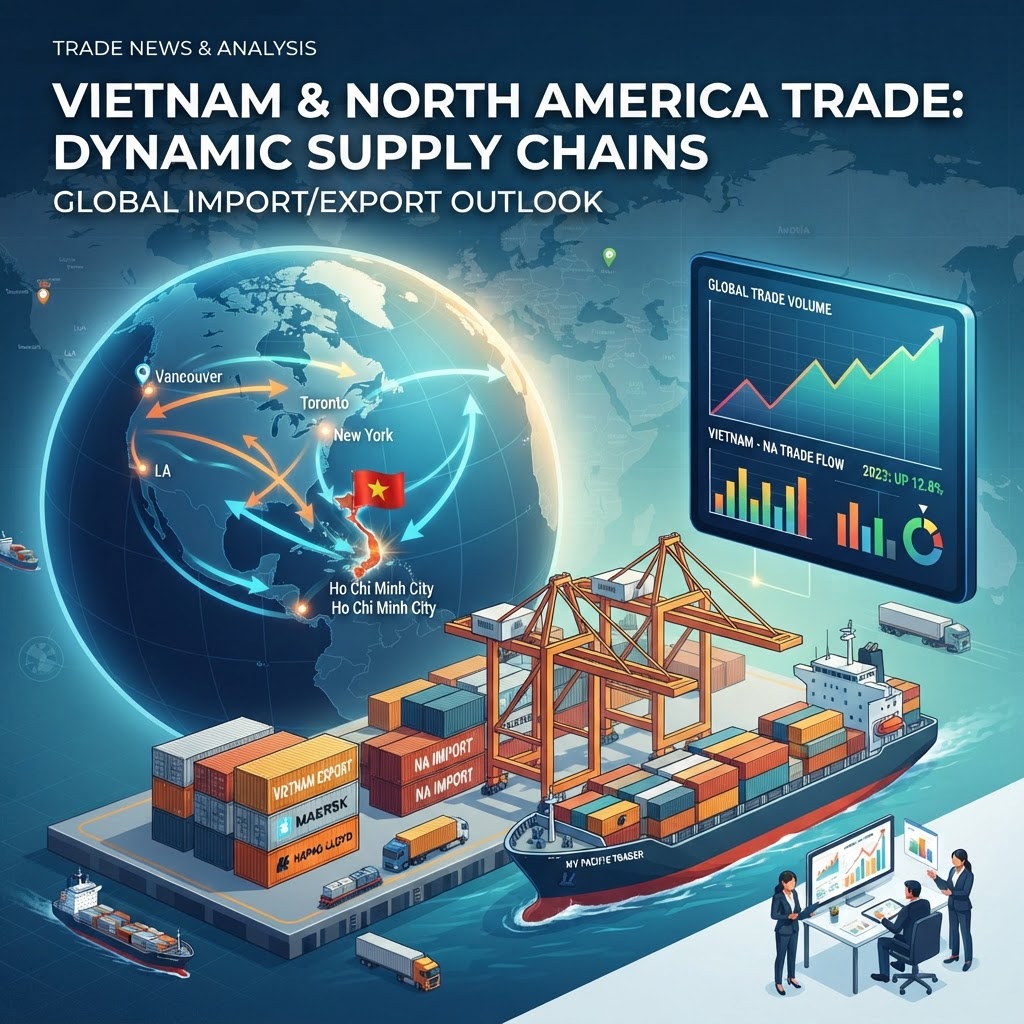
Navigating the 2026 Trade Landscape: Resilience, Deficits, and Shifting Alliances
An analysis of the mid-2026 global trade environment, covering the robust expansion in technology sectors, Vietnam's strategic trade deficit, and rising protectionist tensions in North America.
As we pass the midpoint of 2026, the global trade landscape is defined by a dichotomy: while innovation and high-tech demand continue to propel value upward, geopolitical friction and strategic shifts are creating a complex web of challenges for supply chain managers and global investors. With global goods trade reaching $13.7 trillion in the first half of the year, trade professionals must balance optimism regarding sector-specific growth against the realities of cooling diplomatic relations and protectionist policy shifts in major economies. ## The High-Tech Engine of Global Trade The first half of 2026 has been marked by a 12.5% surge in global goods trade, a performance heavily underpinned by the rapid expansion of artificial intelligence, semiconductors, and electric vehicles. While higher commodity and energy prices contributed significantly to this nominal growth, the core story remains the structural transition toward tech-intensive economies. For industry leaders, this suggests that despite broader economic uncertainties, the investment appetite for advanced manufacturing components remains insatiable. The challenge now lies in navigating the uneven recovery across regions, where infrastructure readiness often dictates the success of integrating into these high-value supply chains. ## Vietnam: A Strategic Deficit and Expanding Ties Vietnam remains a focal point for global manufacturing shifts, currently posting a trade deficit of $16.65 billion for the first half of 2026. While raw deficit numbers often trigger alarm, analysts view this as a classic 'developmental deficit.' The surge in imports of machinery and industrial raw materials signifies that Vietnam is effectively scaling its production capacity to feed future export growth. However, this growth is not without regulatory complexity. The U.S. is currently applying pressure regarding non-tariff barriers and rules-of-origin compliance to prevent the transshipment of Chinese goods. Concurrently, Vietnam is successfully diversifying its economic dependencies, evidenced by a deepening partnership with Canada. By leveraging the CPTPP and expanding into green energy and digital trade, Vietnam is positioning itself as a vital, albeit scrutinized, node in the global supply chain. ## North American Trade Turbulence Across the Pacific, the trade climate in North America has turned increasingly volatile. Recent escalations in tariff threats—specifically the U.S. administration's proposal of 50% tariffs on various Canadian imports—have signaled a move toward more aggressive protectionism aimed at narrowing bilateral trade deficits. These measures challenge the stability of long-standing agreements and force companies with integrated cross-border supply chains to reassess their operational footprints. The friction between the U.S. and its partners suggests that trade policy in 2026 is increasingly being weaponized to address domestic political concerns, necessitating a proactive approach to risk management for firms operating within the CUSMA region. ## Key News Sources 1. Global Trade Powers Ahead in 2026 Driven by High-Tech Goods Despite Growing Uncertainties 2. Vietnam posts trade deficit as imports outpace exports in first half 3. US pushes Vietnam on trade barriers, IP violations in talks 4. Vietnam, Canada see vast potential for more substantive, effective relations 5. U.S. President Donald Trump's latest escalation of his tariff campaign against Canada ## Conclusion The 2026 trade environment requires a pivot from traditional forecasting to a more agile, risk-attuned strategy. While high-tech sectors provide a clear growth vector, the rising tide of protectionism and the increasing scrutiny of transshipment practices demand higher levels of transparency and compliance from global firms. As markets like Vietnam continue to build out their industrial base through strategic partnerships, organizations must remain vigilant, diversifying their regional dependencies and preparing for a landscape where trade policy is increasingly subject to sudden, domestic-centric shifts.
Key News Sources
-
Global Trade Powers Ahead in 2026 Driven by High-Tech Goods Despite Growing Uncertainties (The Ritz Herald) Global goods trade reached approximately $13.7 trillion in the first half of 2026, marking a 12.5% increase largely influenced by higher energy and commodity prices. Growth was particularly strong in technology-intensive sectors like artificial intelligence, semiconductors, and electric vehicles, though trade performance remains uneven across regions.
-
Vietnam posts trade deficit as imports outpace exports in first half (Vietnam Investment Review) Vietnam recorded a trade deficit of $16.65 billion in the first half of 2026, with total import-export turnover reaching nearly $550 billion. Experts characterize this deficit as a positive sign, as it is driven primarily by the import of machinery, raw materials, and production inputs to fuel long-term export growth.
-
US pushes Vietnam on trade barriers, IP violations in talks (straitstimes.com) The United States is currently negotiating with Vietnam to address non-tariff barriers, intellectual property protections, and alignment on export controls. These talks follow investigations into Vietnam's trade practices, including concerns over the transshipment of Chinese goods and the need for stricter rules of origin.
-
Vietnam, Canada see vast potential for more substantive, effective relations (VnEconomy) Vietnam and Canada are looking to deepen their economic partnership, with leaders highlighting the success of the CPTPP in doubling two-way trade over the past five years. Both nations are actively working to expand cooperation in the green economy, energy, and digital trade while preparing for upcoming multilateral forums.
-
U.S. President Donald Trump's latest escalation of his tariff campaign against Canada (BNN Bloomberg) The U.S. administration has announced plans to impose 50% tariffs on a range of Canadian goods, including cement, liquor, and hockey sticks, citing a need to address the U.S. trade deficit. Canadian officials have condemned the move as a violation of existing trade agreements and are coordinating a response to defend domestic workers and industries.
Last updated: July 23, 2026