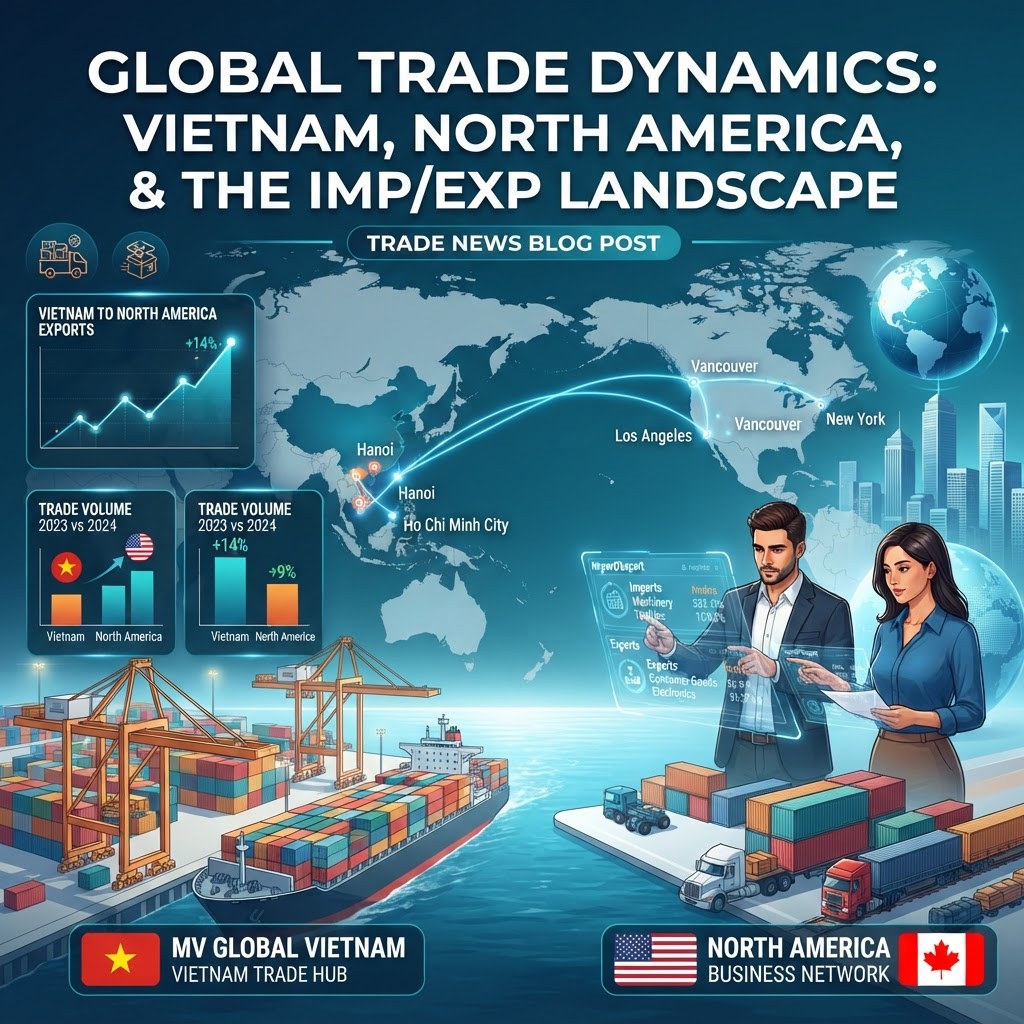
Navigating Global Trade Volatility: Mid-Year 2026 Analysis
An examination of shifting trade dynamics, covering the surge in global commodity costs, Vietnam's industrial growth, and emerging protectionist challenges in North America.
The global trade landscape in the first half of 2026 presents a complex narrative of resilience and friction. As supply chains continue to navigate the post-pandemic reality, trade data reveals a striking divergence between value and volume, while policy interventions in North America introduce new layers of uncertainty for international partners. For trade professionals, monitoring these developments is critical to mitigating risks in an increasingly volatile regulatory environment. At a macro level, global goods trade hit US$13.7 trillion in the first half of 2026, a 12.5% increase year-on-year. However, a deeper analysis from UNCTAD suggests that this expansion is heavily weighted by surging energy and commodity prices rather than a true expansion in the volume of goods crossing borders. This price-driven growth masks underlying stagnation in productivity in several regions and signals persistent inflationary pressure on international supply chains. Vietnam stands out as a focal point of these shifts, recording a robust import-export turnover of nearly US$550 billion in the first six months of 2026, a massive 27.1% increase over 2025. While a trade deficit of US$16.65 billion might trigger alarms in some economies, Vietnamese authorities view this as essential 'working capital' designed to fuel rapid industrial recovery and infrastructure development. However, this export-oriented strategy is encountering significant headwinds. The U.S. government recently imposed a 12.5% tariff on Vietnamese imports under Section 301, citing concerns over labor practices. This development forces manufacturers operating in or sourcing from Vietnam to re-evaluate their compliance frameworks and supply chain cost structures immediately. Simultaneously, the North American trade corridor is facing unprecedented strain. Despite recent high-level dialogues between Canadian and Vietnamese leadership aimed at deepening economic ties through the CPTPP and a potential Canada-ASEAN free trade agreement, the U.S. has adopted a sharply protectionist stance against its northern neighbor. The recent 50% tariff imposition on Canadian goods like dairy, motor vehicles, and alcohol under Section 338 marks a significant departure from CUSMA norms. This creates a challenging environment for Canadian exporters and complicates regional integration efforts. Trade professionals should prioritize the following actions: (1) Diversify sourcing dependencies to account for sudden regulatory shifts; (2) Enhance transparency in labor and production reporting to preempt trade investigations; and (3) Closely monitor bilateral tariff exemptions that may emerge during diplomatic negotiations. Navigating these currents requires agility and a keen focus on both geopolitical signals and macroeconomic data. Key News Sources: 1. Global Trade Experiences Uneven Expansion in First Half of 2026 (https://unctad.org) 2. Vietnam’s Import-Export Turnover Reaches Nearly US$550 Billion in H1 2026 (https://vietnamnews.vn) 3. U.S. Imposes 12.5% Additional Tariff on Vietnamese Imports Under Section 301 (https://tuoitre.vn) 4. Canadian and Vietnamese Prime Ministers Discuss Expanding Economic Ties (https://pm.gc.ca) 5. U.S. Administration Announces 50% Tariffs on Key Canadian Goods (https://whitecase.com). In conclusion, the global trade environment is entering a period where domestic political priorities are increasingly overriding established international trade agreements. While growth numbers remain high, the sustainability of this expansion is threatened by rising protectionism and cost-push inflation. Businesses must transition from a model of 'just-in-time' efficiency to one of 'just-in-case' resilience.
Key News Sources
-
Global Trade Experiences Uneven Expansion in First Half of 2026 (UN Trade and Development (UNCTAD)) Global goods trade reached approximately US$13.7 trillion in the first half of 2026, marking a 12.5% increase year-on-year. While East Asia led the growth, much of the rise is attributed to higher prices for energy and commodities rather than increased trade volumes.
-
Vietnam’s Import-Export Turnover Reaches Nearly US$550 Billion in H1 2026 (Vietnam News) Vietnam recorded a total import-export turnover of US$549.69 billion in the first six months of 2026, a 27.1% increase compared to 2025. Although the country saw a trade deficit of US$16.65 billion, officials view this as positive 'working capital' fueling production and industrial recovery.
-
U.S. Imposes 12.5% Additional Tariff on Vietnamese Imports Under Section 301 (Tuoi Tre News) The U.S. Trade Representative has finalized a 12.5% tariff on Vietnamese goods following a Section 301 investigation into forced labor practices. Vietnam's Ministry of Foreign Affairs expressed disappointment, stating the move fails to reflect the country's ongoing legal reforms and strict anti-forced labor measures.
-
Canadian and Vietnamese Prime Ministers Discuss Expanding Economic Ties (Government of Canada) In a phone call, Prime Minister Mark Carney and Prime Minister Lê Minh Hưng emphasized the potential to strengthen bilateral trade in aerospace, energy, and agri-food. The leaders discussed concluding a Canada-ASEAN free trade agreement and utilizing the CPTPP to further deepen their economic partnership.
-
U.S. Administration Announces 50% Tariffs on Key Canadian Goods (White Case) President Trump has invoked Section 338 of the Tariff Act of 1930 to impose 50% tariffs on several Canadian products, including dairy, alcoholic beverages, and motor vehicles. Prime Minister Mark Carney condemned the move as a violation of the Canada-United States-Mexico Agreement (CUSMA) and a threat to Canadian sovereignty.
Last updated: July 27, 2026