Navigating the 2026 Global Trade Landscape: A Triple-Region Analysis
An analysis of evolving global trade dynamics, focusing on Vietnam's manufacturing shifts, North American tariff tensions, and the persistent pressure of rising costs on international supply chains.
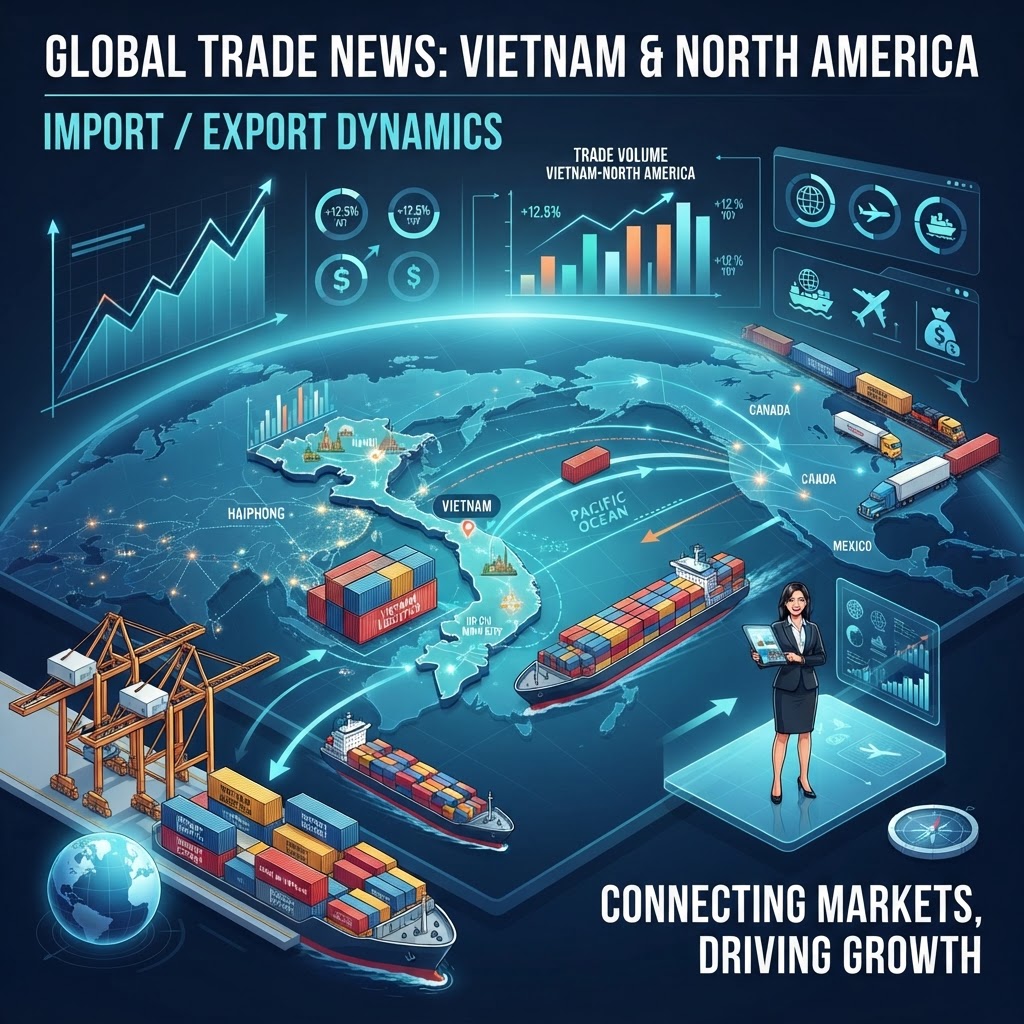
As we move through the second half of 2026, the global trade landscape is defined by a paradoxical climate: while trade volumes continue to expand, the operational environment is increasingly strained by volatile price pressures and protectionist shifts. For trade professionals, navigating this period requires a granular understanding of how regional policy decisions in Southeast Asia and North America are recalibrating global supply chains. The mid-year UNCTAD reports signal that global trade resilience remains high, yet the margin for error for logistics and procurement teams is shrinking. In Vietnam, the economic narrative is one of structural evolution hampered by short-term macroeconomic imbalances. The country’s push toward high-tech manufacturing, bolstered by strategic Free Trade Agreements with nations like Canada, is clearly paying dividends in terms of market integration. However, this growth has come at a cost; the record trade deficit of $5.21 billion recorded in May 2026 highlights the vulnerability of domestic industries to rising raw material prices and external competition. Vietnam’s manufacturers are now caught in a delicate balance: managing the transition to high-value exports while shielding local agricultural sectors from the competitive pressures inherent in trade liberalization. The impending shadow of U.S. tariff policies adds a layer of uncertainty that could reshape the country's export trajectory in the coming quarters. Across the Pacific, North American trade is currently experiencing its most volatile stretch in recent years. The escalating trade friction between Canada and the United States, marked by the announcement of 50% tariffs on key Canadian goods effective August 2026, represents a significant deviation from long-standing cooperative norms. While Canada has taken steps to de-escalate by removing specific counter-tariffs, the persistence of levies on critical materials like steel, aluminum, and automobiles suggests a long-term structural conflict. Professionals should monitor these developments closely, as they threaten to drive up input costs for manufacturing sectors across the continent. To mitigate these risks, organizations must adopt a strategy of 'strategic hedging.' This includes diversifying supply chains to reduce reliance on vulnerable regions, renegotiating contract terms to account for sudden tariff shocks, and leveraging existing free trade networks to optimize duty-free cross-border movement where possible. Key News Sources: Global Trade Update (July/August 2026) (https://unctad.org/publication/global-trade-update-julyaugust-2026-global-trade-continues-expand-amid-rising-price); Vietnam posts record trade deficit as US renews tariff risks (https://theedgemalaysia.com/node/805648); U.S. International Trade in Goods and Services, April 2026 (https://www.bea.gov/news/2026/us-international-trade-goods-and-services-april-2026); Vietnam’s International Free Trade Agreements (https://www.vietnam-briefing.com/doing-business-guide/vietnam/why-vietnam/vietnam-s-international-free-trade-and-tax-agreements); Canada-U.S. Trade War (https://www.cfib-fcei.ca/en/site/us-tariffs). In conclusion, the 2026 trade environment demands a proactive and defensive posture. Whether it is navigating Vietnam's complex integration into the global value chain or managing the fallout of the Canada-U.S. tariff dispute, agility is the currency of the year. Companies that prioritize transparency in their procurement and responsiveness in their policy monitoring will be the best positioned to navigate these turbulent waters.
Key News Sources
-
Global Trade Update (July/August 2026): Global trade continues to expand amid rising price pressures (UN Trade and Development (UNCTAD)) Global trade is continuing to expand despite facing challenges from rising price pressures. The report highlights the ongoing evolution of international trade dynamics as of mid-2026.
-
Vietnam posts record trade deficit as US renews tariff risks (The Edge Malaysia) Vietnam's trade deficit reached a record high of $5.21 billion in May 2026 as imports surged due to rising global raw material prices. Meanwhile, exporters are bracing for potential new tariff risks from the United States.
-
U.S. International Trade in Goods and Services, April 2026 (U.S. Bureau of Economic Analysis (BEA)) The U.S. goods and services deficit was $55.9 billion in April 2026, with Vietnam identified as one of the countries with which the U.S. recorded a significant trade deficit. The report provides detailed breakdowns of U.S. trade balances across various international partners.
-
Vietnam’s International Free Trade Agreements (Vietnam Briefing) Vietnam has actively expanded its trade network through numerous Free Trade Agreements, including those with Canada, to shift toward high-tech manufacturing. While these agreements offer growth, local sectors like agriculture face increased competition from imports from countries including Canada.
-
Canada-U.S. Trade War (Canadian Federation of Independent Business (CFIB)) The U.S. has announced 50% tariffs on various Canadian products effective August 19, 2026, prompting the Canadian government to intensify trade negotiations. Additionally, Canada recently removed 25% counter-tariffs on certain U.S. goods, though tariffs on steel, aluminum, and automobiles remain in place.
Last updated: August 2, 2026