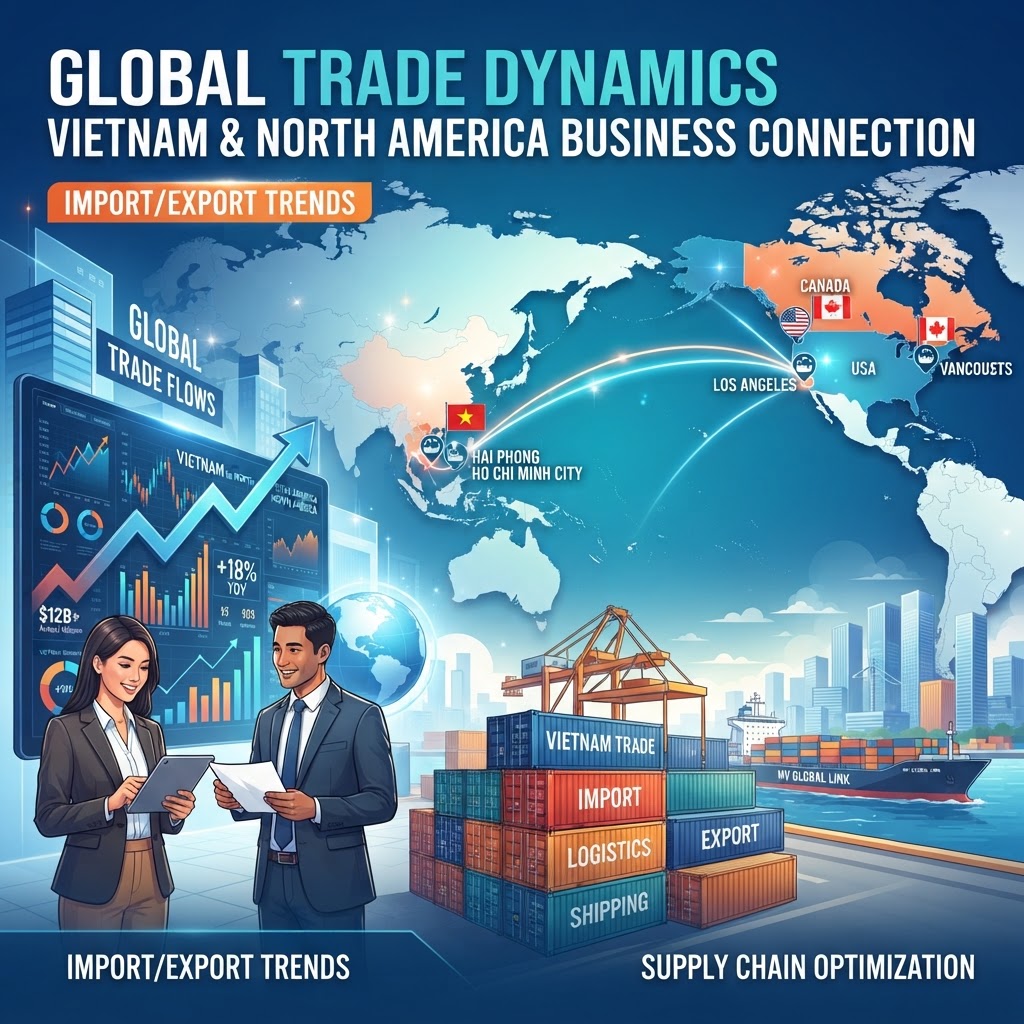
Navigating the 2026 Trade Landscape: A Tri-Regional Analysis
A deep dive into the shifting dynamics of global trade, Vietnam's evolving export market, and the complexities of North American trade relations in 2026.
The global trading environment in 2026 presents a complex tapestry of growth, geopolitical tension, and shifting regulatory landscapes. As trade professionals look to navigate these uncertain waters, understanding the macro-level drivers alongside specific regional developments is essential for effective supply chain and market entry strategies. With global goods trade reaching $13.7 trillion in the first half of 2026—a 12.5% increase year-over-year—the surface numbers suggest robustness. However, beneath this growth lies the sobering reality of price-driven expansion fueled by heightened energy and logistics costs, rather than pure volume growth. This trend necessitates a recalibration of how businesses perceive market health and cost efficiency. Vietnam continues to position itself as a critical player in global manufacturing, even as it faces new regulatory headwinds in the form of U.S. Section 301 tariffs. Meanwhile, the North American corridor remains a focal point of friction, defined by ongoing tariff disputes between the U.S. and Canada. For global businesses, these developments underscore the need for flexible, risk-mitigated strategies. Vietnam's 2026 trade outlook, currently estimated at $890 billion, highlights the nation's critical role in electronics and machinery exports. However, the recent introduction of U.S. Section 301 tariffs, stemming from investigations into forced labor practices, introduces immediate trade compliance risks. Firms sourcing from or exporting to Vietnam must prioritize supply chain transparency and rigorous labor audits to maintain market access. Despite these challenges, Vietnam remains attractive, as evidenced by strategic partnerships like the one between Export Development Canada (EDC) and VinaCapital, aimed at bolstering bilateral investment. The North American trade theater remains similarly fraught. While the bilateral relationship between the U.S. and Canada has seen some reprieve following the termination of certain retaliatory measures in 2025, the persistence of tariffs on U.S. vehicles highlights the lingering protectionist sentiment. Trade professionals operating in this region should monitor policy shifts closely, as domestic political pressures continue to influence trade enforcement, creating a climate where regulatory changes can happen abruptly. Key News Sources: Global Trade Update (July/August 2026): Global trade continues to expand amid rising price pressures (https://unctad.org/publication/global-trade-update-julyaugust-2026-global-trade-continues-expand-amid-rising-price); The Vietnam Import-Export Trade Outlook of 2026: Latest Market Updates (https://www.importglobals.com/blog/the-vietnam-importexport-trade-outlook-of-2026-latest-market-updates); US Imposes Section 301 Tariff on Vietnam: Key Measures and Business Implications (https://www.vietnam-briefing.com/news/us-section-301-forced-labor-investigation-new-trade-compliance-risks-for-vietnam-exporters.html/); EDC, VinaCapital partner to boost Canada–Vietnam trade and investment (https://en.vneconomy.vn/tag/trade); U.S.-Canada Trade Relations (https://www.congress.gov/crs-product/IF12595). In conclusion, the 2026 trade landscape is characterized by a paradox of growth and volatility. For the professional, the key to navigating this environment lies in diversification and extreme diligence regarding compliance. Moving beyond top-line growth figures to analyze cost drivers, political risks, and regulatory shifts is no longer optional—it is a competitive necessity. By staying agile and fostering strong regional partnerships, businesses can continue to leverage emerging opportunities despite the prevailing headwinds.
Key News Sources
-
Global Trade Update (July/August 2026): Global trade continues to expand amid rising price pressures (UNCTAD) Global goods trade reached approximately US$13.7 trillion in the first half of 2026, marking a 12.5% increase compared to the same period in 2025. However, a significant portion of this growth is attributed to higher prices rather than increased trade volumes, driven by rising energy and logistics costs.
-
The Vietnam Import-Export Trade Outlook of 2026: Latest Market Updates (ImportGlobals) Vietnam's total trade value in 2026 is estimated at US$890 billion. Major exports include electronics and machinery, while key imports consist of semiconductors, chemicals, and electrical equipment.
-
US Imposes Section 301 Tariff on Vietnam: Key Measures and Business Implications (Vietnam Briefing) The United States has imposed Section 301 tariffs on Vietnam following investigations into forced labor practices. These measures introduce new trade compliance risks for Vietnamese exporters targeting the U.S. market.
-
EDC, VinaCapital partner to boost Canada–Vietnam trade and investment (VnEconomy) Export Development Canada (EDC) and VinaCapital have formed a partnership to strengthen bilateral trade and investment. This initiative follows significant growth in trade between the two nations, which reached $15.7 billion in 2024.
-
U.S.-Canada Trade Relations (Congressional Research Service) Trade relations between the U.S. and Canada have been strained by Section 232 tariffs on steel and aluminum, leading to Canadian retaliatory tariffs on U.S. goods. While some retaliatory measures were terminated in September 2025, tariffs on U.S. vehicles remain in effect.
Last updated: September 2, 2026