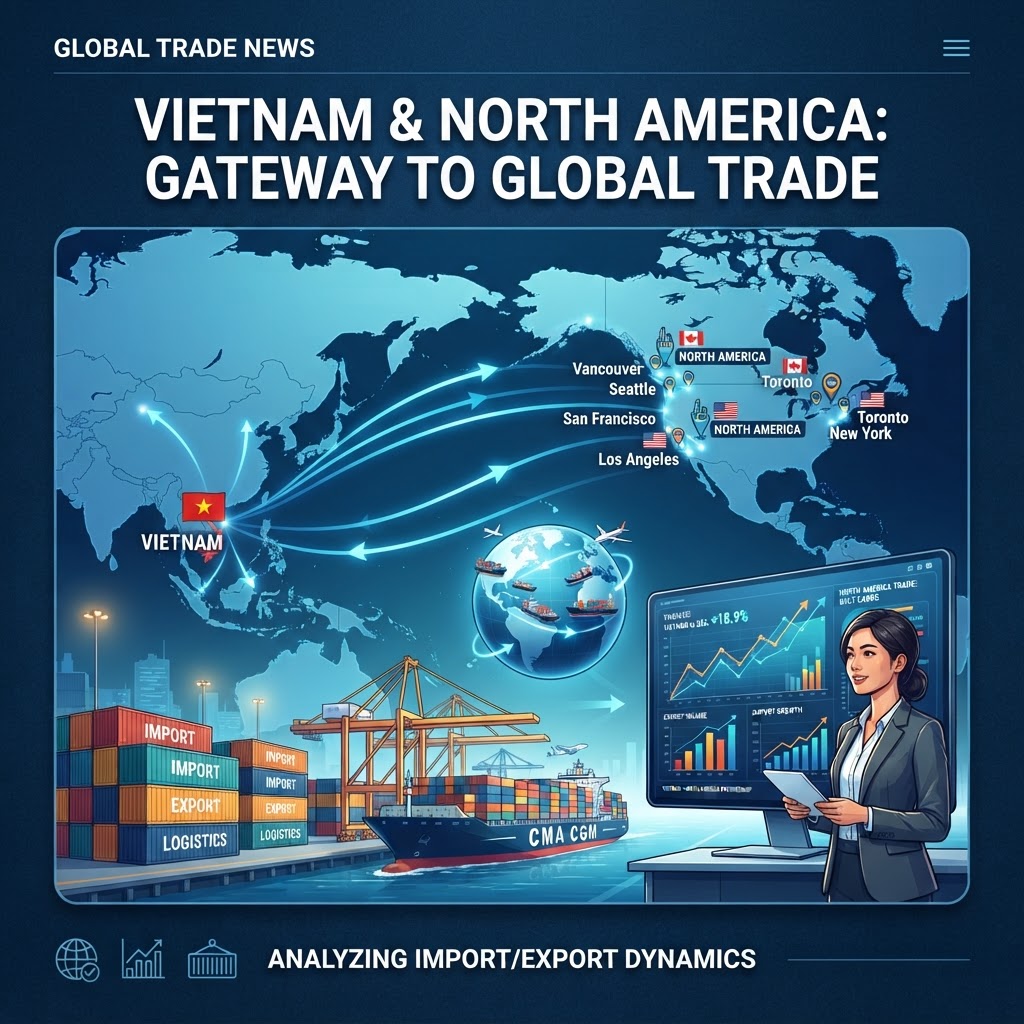
Navigating the New Trade Landscape: From Digital Transformation to Regional Shifts
A deep dive into the evolving global trade environment, highlighting Vietnam's rising prominence, the digital services shift, and the escalating volatility in North American trade relations.
The global trade landscape in late 2026 is defined by a dichotomy of rapid digital evolution and profound geopolitical friction. As supply chains reconfigure and service-oriented economies gain momentum, trade professionals must balance the opportunities of emerging markets like Vietnam against the destabilizing risks of major bilateral tariff disputes in North America. Understanding these shifting tides is essential for maintaining supply chain resilience and identifying growth corridors in an increasingly fragmented world. Global trade is undergoing a structural pivot. While merchandise trade remains critical, services—particularly those that are digitally deliverable—are the new frontier, accounting for 27% of total exports as of 2025. However, this growth has not been uniform. While digitally enabled trade grows at an average of 7.1% annually, there is a mounting concern regarding a 'digital divide' that leaves least developed nations behind. For businesses, this suggests that investment in digital infrastructure and compliance with emerging fragmented trade rules will be the key competitive differentiator for the remainder of the decade. Vietnam has emerged as a cornerstone of this new manufacturing and trade order. With a trade turnover surpassing $825 billion by mid-September 2026—a 29.4% year-on-year increase—the nation is clearly benefiting from the 'China Plus One' strategy. Electronics and machinery are leading this charge, yet the country’s $23.5 billion trade deficit highlights the intense pressure on its production inputs. To mitigate this, Vietnam is actively diversifying its alliances. The potential for a reciprocal trade agreement with the United States, aimed at balancing the trade ledger through increased imports of high-tech and infrastructure goods, offers a template for how emerging economies can stabilize their growth. Simultaneously, Vietnam’s move to deepen production linkages with Canada via the CPTPP framework signals a strategic effort to integrate into high-value manufacturing chains. In stark contrast to the growth-oriented activities in Southeast Asia, North American trade is currently grappling with a period of severe volatility. The deteriorating relationship between the US and Canada has resulted in a retaliatory cycle of 50% tariffs and product-specific bans that effectively dismantle years of integrated market efficiency. For firms operating across these borders, the instability regarding automotive, dairy, and consumer goods suggests a need for rapid contingency planning. The uncertainty caused by these disputes underscores the risks of relying on legacy trade agreements that are currently being stress-tested by modern protectionism. Professionals should prioritize supply chain diversification, shifting away from over-reliance on any single corridor currently experiencing geopolitical friction. In North America, this means auditing cross-border dependencies and preparing for fluctuating tariff costs. In Southeast Asia, businesses should look toward the long-term potential of US-Vietnam alignment, specifically in technology, renewable energy, and critical mineral sectors, where reciprocal agreements are likely to create new, stable market access. Key News Sources: Services Reshaping Global Trade, Yet Digital Divides Persist | Vietnam’s Trade Turnover Surpasses $825 Billion by Mid-September | US and Vietnam Near Finalization of Reciprocal Trade Agreement | Vietnam and Canada Seek to Expand Economic Cooperation Beyond Trade | Escalating Trade Dispute Between US and Canada Results in New Tariffs and Bans. As we look to the close of 2026, the mandate for trade professionals is clear: agility is the only defense against volatility. By leveraging the growth of the digital economy and aligning with stable, emerging manufacturing hubs like Vietnam, firms can hedge against the protectionist shifts currently reshaping the North American continent. Strategic foresight, built upon data-driven regional analysis, will remain the hallmark of successful global trade operations.
Key News Sources
-
Services Reshaping Global Trade, Yet Digital Divides Persist (UN Trade and Development (UNCTAD)) Global trade is increasingly driven by services, which accounted for 27% of total exports in 2025. While digitally deliverable services are growing rapidly—averaging 7.1% annual growth over the past decade—least developed countries are lagging behind, creating concerns that artificial intelligence and fragmented trade rules may deepen existing economic divides.
-
Vietnam’s Trade Turnover Surpasses $825 Billion by Mid-September (Vietnam Investment Review) Vietnam's total trade turnover reached over $825 billion by mid-September 2026, marking a 29.4% increase year-on-year, driven largely by electronics, machinery, and manufacturing exports. Despite this strong performance, the country faces a trade deficit of approximately $23.5 billion as imports of production inputs grew faster than exports.
-
US and Vietnam Near Finalization of Reciprocal Trade Agreement (The Investor (theinvestor.vn)) Vietnamese President To Lam and US Trade Representative Jamieson Greer confirmed that both nations are very close to reaching a reciprocal, fair, and balanced trade agreement. To help narrow the significant trade deficit, Vietnam has pledged to increase its imports of American high-tech goods, including commercial aircraft, nuclear energy equipment, and infrastructure materials.
-
Vietnam and Canada Seek to Expand Economic Cooperation Beyond Trade (Tuoi Tre News) Ahead of a historic state visit by President To Lam, officials are focusing on elevating bilateral ties to a strategic level, moving beyond simple goods exchange to deep production linkages. The two countries aim to enhance cooperation in clean energy, critical minerals, advanced technology, and manufacturing, building on the foundation of the CPTPP.
-
Escalating Trade Dispute Between US and Canada Results in New Tariffs and Bans (Blank Rome LLP) The trade relationship between the US and Canada has deteriorated, with the US imposing 50% tariffs on approximately $20 billion worth of Canadian goods and announcing bans on specific alcohol, dairy, and automotive products effective September 29. In response, Canada implemented its own retaliatory tariffs on US goods, with both nations struggling to resolve the breakdown in trade negotiations.
Last updated: September 22, 2026